|
Bus Glossary - Motor Coach
Industries |
|
• Motor Coach Industries
is North America's leading motorcoach manufacturer and has been in business for over 70 years.
|
|
###X(L)3/X##00
Series |
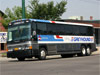 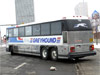 |
96-A2, 96-A3, 102-A2, 102-A3 |
|
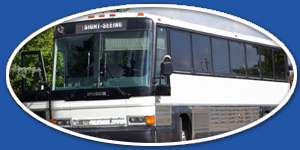 |
The A-series coaches were
produced from 1985 to 1992. They look very similar to the
popular C series, but they are not the same. The
headlights are the main feature used to distinguish these buses
apart. Because this bus had the same taillights as the
102-C3, it is easy to confuse them. This model and the
102-B3 were the only buses to have a destination sign area built
into the bus. |
|
  |
102-C3 |
|
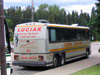
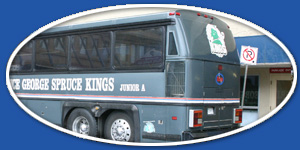
The 102-C3 is the
predecessor of the D-series. The front end is nearly the
same as the D-series, but the rear lights are the same as the
A-series. The slant in the rear tells us that the coach is
a 102-C3 instead of a 102-D3. This model was produced
between 1987 and 1993. Some late model C-Series coaches
had a rear end similar to the D-Series. The last 102C3
rolled off the production line in December 1993. |
 |
|
 |
102-D3, 102-DL3, D4000,
D4500 |
|
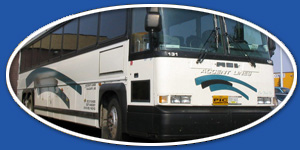 |
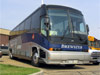
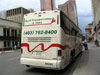
The D-series is the
reliable workhorse of MCI's line of coaches. Introduced in
1992, the D-series represents a major turning point in the
history of MCI. It has a completely redesigned rear end,
and was the first MCI coach to be built in the United States
with a length of 45 feet. The new Detroit Diesel Series 60
engine became the standard engine for the D-Series. A 40-foot version, the 102D3,
was introduced in 1994. A, B,
and C-Series coaches could not accommodate the bigger engine
size. This series of buses is still in production as the D4000 and
D4500, and is available with stainless steel siding. |
|
  |
102-EL3, E4500 "Renaissance" |
|
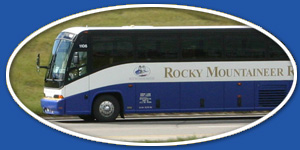
The E-Series is the
top-of-the-line flagship model in MCI's lineup. Introduced
in 1997, it was a successful attempt to create a high-tech, luxurious
coach. It was designed with help from BMW engineers. Currently, the E-Series is the most popular
conversion shell on the market. The E-Series is known for
its distinct rounded front end and curling stairwell. |
 |
|
|
|
F3500 |
|
 |
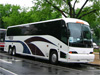
The F-Series is perhaps the
oddest, most interesting coach in MCI's lineup. The
F-Series was originally produced by Mexican-based Dina as the
model 330. Its suspension was based off the legendary Flxible Metro, which is renowned for its soft, cushy ride.
Dina went out of business in the late 1990s, and MCI stepped in
to continue production of the 330, which MCI dubbed the "F"
Series. Since then, the F-Series has become very popular
with limo companies and small transit agencies, but it is now
discontinued. |
|
  |
J4500 |
|
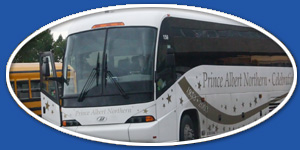 |
The J-Series represents a
mid-level hybrid coach. Introduced in 2001, it combines
the modern styling of the E-Series, with the affordability,
simplicity and toughness of the D-Series. Because it
offers the best of both worlds, the J-Series is marketed far
more than the D and E-Series. The J-Series can be
recognized by the "bald" area above the windshield and its
clear, enclosed, round LED taillight fixtures. |
|
  |
TC40102N "Classic" |
|
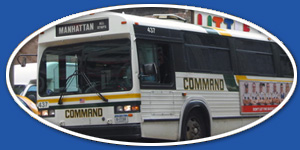
The transit bus dubbed the
"Classic" was originally introduced by General Motors.
Production of this model by MCI began in 1987 and lasted
until 1993, when it was sold to Nova Bus. The "Classic"
was the successor to the extremely popular GM "Fishbowl" model,
and as a result was also very successful. MCI's only
progression with the "Classic" was introducing an articulated
model, but only a small number of these were sold. |
 |
|
Site
designed and maintained by A. Wong.
Copyright © 2004-2005. All Rights Reserved.
This hobby website is not associated with any of the featured companies.
|


